Key Takeaways
Key Takeaways
SEX7 minute read
How to Fix ED That's All in Your Head

If you can achieve an erection during masturbation or wake up with morning erections but struggle during partnered sex, psychological factors may be part of the picture. The phrase “all in your head” can make the issue sound imaginary, but psychological ED can involve real mind-body responses. Stress, anxiety, self-monitoring, and relationship pressure can all affect arousal and make erections less reliable in certain situations.
Psychological factors can play a meaningful role in ED. A review on the psychology of erectile dysfunction describes stress, depression, performance worry, and shifts in attention as contributors to erectile problems. The reassuring part is that psychological ED is not a personal failure. It is a pattern that can often improve with the right mix of education, stress management, communication, professional guidance, and, when appropriate, prescription support.
Understanding how mental pressure affects physical response is the first step toward getting out of the loop.
Key Takeaways
- Psychological ED can happen when stress, anxiety, relationship strain, or self-monitoring interferes with erections
- Situational patterns, such as erections during masturbation or upon waking but difficulty with partnered sex, may suggest a psychological component
- Mindfulness, communication, sex therapy, and cognitive behavioral strategies can help reduce performance pressure
- A healthcare provider can help determine whether ED is psychological, physical, or a combination of both
- Prescription ED support may be useful when erectile concerns are adding to the anxiety cycle

Understanding Psychological ED and Performance Anxiety
Psychological erectile dysfunction, sometimes called psychogenic ED, happens when mental or emotional factors interfere with the ability to get or maintain an erection sufficient for sexual activity. Unlike ED that is primarily physical, psychological ED may show up suddenly or only in specific situations.
How Mental Pressure Affects Erectile Function
Erections depend on coordination between the brain, nerves, hormones, blood vessels, and sexual stimulation. When your body is relaxed and responsive to arousal, blood flow to the penis can increase. When anxiety takes over, the body may shift toward a stress response instead.
Stress and performance pressure may contribute to ED by:
- Pulling attention away from sensation and arousal
- Increasing self-monitoring during sex
- Making the body feel tense or guarded
- Turning one difficult experience into anticipatory worry before the next encounter
- Making partnered sex feel like a test instead of a shared experience
This is why someone may have erections during solo sex or upon waking but struggle with a partner. The physical ability may still be present, but pressure changes the context.
Common Causes of Performance Anxiety in Men
Performance anxiety often builds from a mix of personal, relational, and situational factors.
Common triggers include:
- Fear of disappointing a partner
- A previous erectile difficulty that created doubt
- Work stress, financial stress, or major life changes
- Relationship tension or poor communication
- Body image concerns or low self-esteem
- Depression, anxiety, or intrusive worries
- Unrealistic expectations from media or pornography
The goal is not to identify one single cause every time. It is to notice what tends to activate the cycle and choose strategies that interrupt it.
 Reviewed by a licensed provider
 Strategies Beyond Medication for Mental ED
Medication may help some men, but psychological ED often benefits from approaches that reduce pressure and rebuild trust in the body.
Mindfulness and Stress Reduction Techniques
Mindfulness can help because it trains attention away from anxious predictions and back toward present-moment sensation. This matters because anxiety-related ED often involves cognitive interference: attention shifts from arousal and sensation toward worry, checking, and self-evaluation.
Body scan practice:
- Sit or lie down in a quiet place
- Notice your breathing without trying to force it
- Move attention slowly from your head to your feet
- Notice physical sensations without judging them
- When your mind wanders, gently bring attention back to the body
During intimacy, a simpler version can help: choose one sensation to focus on, such as warmth, pressure, breath, or touch. The point is not to “turn off” thoughts. It is to stop letting them run the whole experience.
Other grounding tools include:
- Slow breathing before intimacy
- Progressive muscle relaxation
- Gentle exercise as part of a regular routine
- A consistent sleep schedule
- Reducing alcohol when it tends to interfere with erections
Communication With Your Partner
Avoiding the topic can make performance anxiety feel bigger. A calm conversation outside the bedroom can reduce pressure and help your partner understand that the issue is not a lack of attraction.
Helpful ways to start:
- “I’ve been getting in my head during sex, and I want to work on it.”
- “Can we take some pressure off and focus more on what feels good?”
- “I’d like us to treat this as something we can navigate together.”
This does not need to become a long or heavy conversation. The goal is to reduce secrecy, invite support, and make intimacy feel less like a pass-fail situation.

When to Consider ED Treatment for Psychological Factors
Self-help strategies can be useful, but persistent ED deserves medical attention. Even if the pattern seems psychological, ED can sometimes overlap with cardiovascular, hormonal, medication-related, or other physical factors.
Signs It May Be Time to Seek Guidance
Consider speaking with a healthcare provider if:
- Erectile difficulties continue or worsen
- ED happens in most situations, not only during partnered sex
- You notice pain, urinary symptoms, or other physical changes
- ED is affecting your mood, relationship, or self-esteem
- You have diabetes, heart disease, high blood pressure, or other health conditions
- You take medications that may affect sexual function
A provider can help sort out whether the concern is mostly psychological, mostly physical, or a combination.
Therapy and Integrated Care
Cognitive behavioral therapy and sex therapy can help men identify unhelpful thought patterns, reduce avoidance, and rebuild intimacy without constant performance monitoring. In men with non-organic ED, a randomized trial of sildenafil, cognitive behavior sex therapy, and integrated treatment found that combined care can be a useful treatment approach.
Sex therapy may include sensate focus, communication exercises, and gradual reintroduction of sexual activities without making intercourse the only marker of success. For many couples, reducing the pressure around “performance” is the turning point.
The Role of Combination Approaches: Addressing Mind and Body
Psychological ED does not always respond to one strategy alone. Some men benefit from working on the mental loop while also addressing the physical worry that keeps the loop active.
How a Combined Approach Can Help
A combined plan might include:
- Education about how anxiety affects arousal
- Mindfulness or grounding exercises
- Partner communication
- Therapy or coaching when needed
- Prescription ED medication when clinically appropriate
This kind of approach can be helpful because the mind and body are not separate during sex. If physical uncertainty is fueling anxiety, prescription support may reduce some of that worry while behavioral strategies address the mental pattern.
Breaking the Anxiety-ED Cycle
The anxiety-ED cycle often starts with one stressful or disappointing experience. After that, the fear of repeating it can become the main problem.
The cycle may look like this:
- A stressful event or prior erectile difficulty creates doubt
- The next intimate moment feels higher pressure
- Self-monitoring replaces pleasure and sensation
- Anxiety makes arousal harder to maintain
- The experience reinforces the original worry
- Avoidance or shame makes the next attempt feel even harder
Ways to interrupt the cycle:
- Use breathing or grounding before intimacy
- Focus on sensation instead of checking your erection
- Talk with your partner outside the bedroom
- Redefine success as connection, pleasure, and comfort
- Consider medical evaluation if ED continues
- Use therapy or sex therapy when anxiety feels persistent
Small changes can matter because the cycle depends on repetition. Each lower-pressure experience helps create a different expectation.
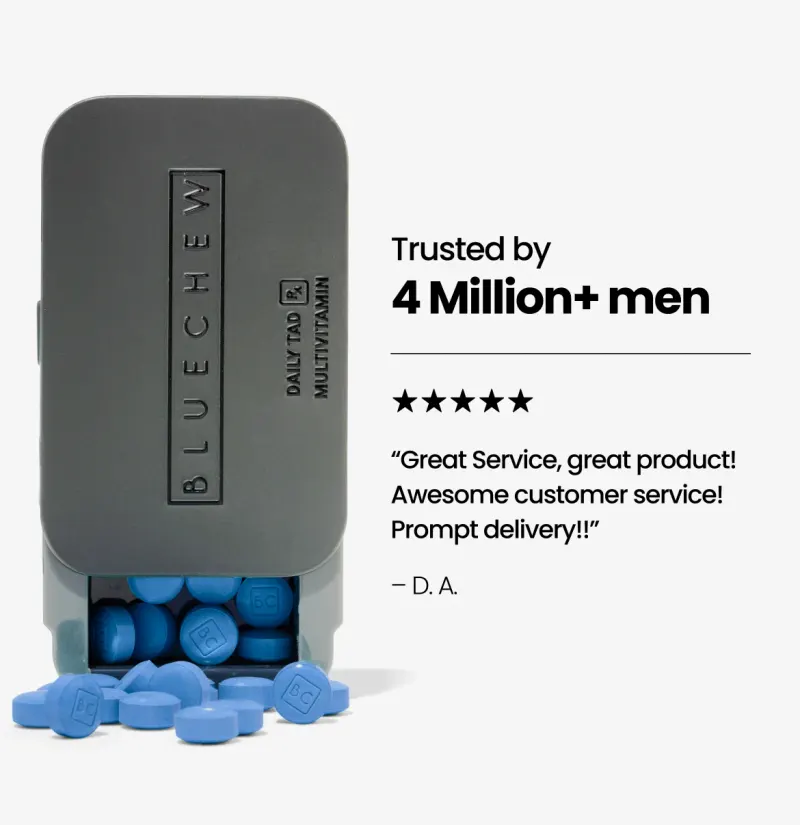
How BlueChew Supports Psychological ED
When erectile concerns keep pulling your attention inward, BlueChew may help address the physical side of the loop while you work on the psychological side. BlueChew provides prescription medications containing the active ingredients sildenafil, vardenafil, and tadalafil. Sildenafil, vardenafil, and tadalafil are the active ingredients in Viagra, Levitra, and Cialis, respectively.
For men whose ED involves both performance pressure and erectile reliability concerns, GOLD may be worth discussing with a provider. GOLD is a sublingual tablet that includes sildenafil, tadalafil, oxytocin, and apomorphine.
BlueChew's complete product lineup includes:
- SIL: 30 mg or 45 mg sildenafil, works within 15 minutes, lasting up to 6 hours
- TAD: 6 mg or 9 mg tadalafil, effective within 15 minutes, lasting up to 36 hours
- VAR: 8 mg vardenafil, takes effect within 15 minutes, lasting up to 6 hours
- DailyTAD: 9 mg tadalafil plus 7 essential vitamins, lasting up to 36 hours
- MAX: 45 mg sildenafil + 18 mg tadalafil combo, lasting up to 36 hours
- VMAX: 14 mg vardenafil + 18 mg tadalafil combo, lasting up to 36 hours
- GOLD: sildenafil, tadalafil, oxytocin, and apomorphine sublingual tablet, lasting up to 36 hours
BlueChew’s online process allows eligible users to complete a medical intake and have prescription options reviewed by a licensed provider. For someone dealing with performance anxiety, that privacy can make it easier to start a conversation about ED support without adding more pressure.
Frequently Asked Questions
Can psychological factors alone cause erectile dysfunction?
Yes. Anxiety, stress, relationship strain, depression, and self-monitoring can all interfere with sexual arousal and erectile response. A systematic review on ED in patients with anxiety disorders found that men with anxiety disorders are a higher-risk group for ED. A common clue is situational ED, such as having erections during masturbation or upon waking but struggling during partnered sex. Still, a healthcare provider can help rule out physical contributors.
How does telemedicine help with ED related to performance anxiety?
Telemedicine may feel easier for men who are hesitant to bring up ED in person. It allows you to complete an intake privately and discuss prescription options from home. That convenience does not replace the need for accurate medical review, but it may reduce some barriers to starting care.
Are there specific medications that can help with the mental aspects of ED?
Standard PDE5 inhibitors, including sildenafil, tadalafil, and vardenafil, primarily support the blood-flow side of erections. They do not replace therapy or stress-management strategies. However, when erectile reliability is part of the anxiety loop, prescription medication may help reduce performance pressure while you work on the psychological side.
How long does it take for psychological ED treatments to start working?
Timelines vary. Some men notice improvement as soon as they understand the anxiety cycle and reduce pressure. Others need more time with mindfulness, therapy, partner communication, or medical support. It is better to track gradual progress than expect a specific week-by-week result.
Is online ED treatment as effective as in-person doctor visits?
Online ED treatment can be a useful starting point for many men, especially when privacy is a major concern. Effectiveness depends on accurate medical review, the right treatment plan, and follow-through. Men with complex symptoms, pain, cardiovascular concerns, or persistent ED should speak with a healthcare provider about the most appropriate care path.
This article is provided for informational purposes only and does not constitute medical advice. The information presented is not a substitute for professional medical advice, diagnosis, or treatment. Always consult your healthcare provider to discuss the risks, benefits, and appropriateness of any treatment.
BlueChew offers access to healthcare providers who may prescribe compounded medications for the treatment of erectile dysfunction.
The featured products include compounded medications that have not been approved by the FDA. Compounded medications may be prescribed under federal law but are not the same as, nor are they generic versions of, any FDA-approved medication. The FDA does not review compounded medications for safety, effectiveness, or manufacturing quality of compounded products. A prescription will only be written if deemed appropriate after the digital consultation by the licensed medical provider. Individual results may vary.
BlueChew is not a compounding pharmacy but a telemedicine service that links patients to licensed medical providers.
BLUECHEW EDITORIAL STANDARDS
BlueChew is committed to providing accurate, clear, and up-to-date health information. Our writers and medical reviewers rely on peer-reviewed research, clinical guidelines, academic institutions, government health agencies, and professional medical organizations. Whenever possible, we cite primary sources and update our content as new evidence becomes available.
See something that needs correction? Let us know at blog@bluechew.com.



 Medically reviewed