Key Takeaways
Key Takeaways
SEX8 minute read
How to Stop Overthinking During Sex

You're in an intimate moment with your partner, and instead of being fully present, your mind starts racing. "Am I doing this right?" "What are they thinking?" "Is this going to work?" Before you know it, you've mentally left the bedroom entirely, even though your body is still there. This pattern is often described as sexual overthinking or "spectatoring," when you become a self-conscious observer of your own performance rather than an engaged participant in the experience.
Overthinking during sex can create a frustrating loop: worry pulls attention away from sensation and connection, which can make it harder to stay aroused, which then creates more worry. Research on sexual performance anxiety describes anxiety as closely associated with sexual difficulties and as something that can be addressed through clinical strategies. The good news is that this cycle can often be interrupted with practical strategies such as present-moment focus, communication, and, when erectile concerns are part of the picture, professional medical guidance.
Whether you're dealing with racing thoughts during intimacy, concerns about erectile function, or difficulty staying present with your partner, this guide offers practical ways to reduce performance pressure and reconnect with the moment.
Key Takeaways
- Sexual overthinking is common, and it can interfere with arousal by shifting attention away from sensation and connection.
- "Spectatoring," or mentally monitoring your own performance, is the pattern to notice and interrupt.
- Mindfulness-style techniques can help redirect attention back to the body and the present moment.
- Partner communication can reduce pressure and make the experience feel less isolating.
- If erectile concerns are part of the cycle, a healthcare provider can help determine whether medical support may be appropriate.

Understanding Performance Anxiety: More Common Than You Think
If you've ever found yourself mentally checking out during sex, you're not alone. Performance anxiety during intimate moments is common, though many people do not talk about it openly.
What Is Sexual Overthinking?
Sexual overthinking happens when attention shifts from physical sensation and connection to self-monitoring. Instead of noticing what feels good or staying tuned in to your partner, you may start evaluating your performance in real time.
Common overthinking patterns include:
- Worrying about whether you'll maintain an erection
- Wondering what your partner is thinking about your performance
- Mentally critiquing your technique or timing
- Calculating how long things are lasting
- Anticipating problems before they happen
This kind of self-monitoring can become distracting. When attention moves away from erotic cues and pleasurable sensations, arousal may become harder to maintain.
Why This Happens
Sex can feel emotionally meaningful, which can make it easy to put pressure on yourself. Cultural messages about male sexuality can add to that pressure by creating unrealistic expectations about performance, stamina, confidence, or consistency.
The goal is not to force yourself to stop thinking. The goal is to notice when your mind has shifted into performance-monitoring mode and gently bring attention back to the experience.
 Reviewed by a licensed provider
 The Mind-Body Connection: Why Your Brain Affects Your Body
Understanding the connection between stress and sexual response helps explain why "just relax" is not always helpful advice.
Your Nervous System at Work
Sexual arousal is easier when the body is in a relaxed state. Overthinking can activate the body's stress response, which may make arousal more difficult.
When anxiety takes over, you may notice:
- Muscle tension
- Shallow breathing
- Racing thoughts
- Difficulty staying focused on physical sensation
- Increased worry about erectile function
This is not a failure of willpower. It is a stress response. When your brain treats an intimate moment like a performance test, your body may respond as if something is wrong.
The Vicious Cycle
Worrying about sexual performance can lead to physical symptoms, which then reinforce the worry. One difficult experience can create anticipatory anxiety about the next encounter, making it harder to feel relaxed and present.
Recognizing the cycle is the first step toward changing it.
Breaking the Cycle: Practical Steps to Reduce Overthinking
Specific techniques can help interrupt the overthinking pattern and redirect attention back to the moment.
Mindfulness Techniques for the Bedroom
Mindfulness does not mean emptying your mind. It means noticing thoughts without getting pulled into them, then returning attention to what is happening right now. A scoping review on mindfulness and men's sexual activity found that mindfulness-related research in men has examined areas such as performance anxiety, sexual desire, and sexual dysfunction.
Practical mindfulness techniques:
- Body scanning: Before intimacy, spend 2-3 minutes mentally scanning your body from head to toe, noticing sensations without judgment.
- Breath awareness: Focus on slow, steady breathing. When thoughts arise, acknowledge them and return focus to your breath.
- Sensation anchoring: During intimacy, deliberately focus on one physical sensation at a time, such as temperature, pressure, or texture.
- The "five senses" reset: If you catch yourself overthinking, mentally note one thing you can see, hear, feel, smell, or taste.
The goal is not to do these techniques perfectly. The goal is to practice returning to the present moment when your mind wanders.
Communication With Your Partner
Partner communication can reduce the pressure to hide what you're experiencing. It can also help your partner understand that distraction or anxiety is not the same thing as disinterest.
Conversation starters that help:
- "I sometimes get in my head during sex. It's not about you, and I'm working on it."
- "Can we slow things down? I want to really feel what's happening."
- "Let's check in with each other more. I want to know what feels good for you."
Open communication can make intimacy feel more collaborative and less like a performance.
Navigating Negative Thoughts: Cognitive Strategies
Cognitive strategies can help you respond to anxious thoughts without letting them take over the moment. A systematic review on cognitive processing factors in sexual function reported that cognitive factors can play an important role in sexual function and dysfunction in both women and men.
Understanding Intrusive Thoughts
Unwanted thoughts can show up during sex, especially when you're anxious. The problem is not necessarily the thought itself. The problem is getting pulled into it, arguing with it, or treating it as proof that something is wrong.
A practical response:
- Acknowledge the thought: "There's that worry again."
- Avoid arguing with it.
- Return attention to physical sensation.
- Continue slowly and without self-criticism.
Challenging Distorted Thinking
Performance anxiety often involves cognitive distortions, such as catastrophizing ("If this doesn't go well, it's a disaster") or mind-reading ("My partner must be disappointed").
Questions to challenge these patterns:
- What evidence do I actually have for this thought?
- What would I tell a friend who had this worry?
- What's the most realistic outcome here?
- Is this thought helping me or hurting me right now?
These questions can help create distance from the thought so it does not control the experience.
Addressing the Physical Component: When Anxiety Links to ED
Sometimes overthinking and erectile concerns become intertwined. When that happens, it may help to address both the psychological and physical sides of the issue.
When ED May Have a Psychological Component
Erectile difficulties can have physical, psychological, or mixed causes. Anxiety, stress, relationship tension, and past negative experiences can all contribute.
Signs anxiety may be part of the picture include:
- Erections are more reliable during masturbation than partnered sex.
- The issue started during a stressful period.
- Performance anxiety is clearly present.
- Worry about erection quality makes the issue worse.
These signs do not rule out physical causes. If erectile difficulties are persistent, new, or concerning, it is best to discuss them with a healthcare provider.
The Combined Approach
For some men, the most helpful approach includes behavioral strategies, partner communication, and medical guidance when appropriate. Behavioral tools can reduce anxiety and performance pressure, while a licensed provider can help determine whether ED medication or another option is appropriate.

Taking Performance Pressure Off the Table With BlueChew
When erectile concerns occupy mental bandwidth, it can be harder to focus on connection and pleasure. Addressing erectile function may help reduce one source of performance pressure.
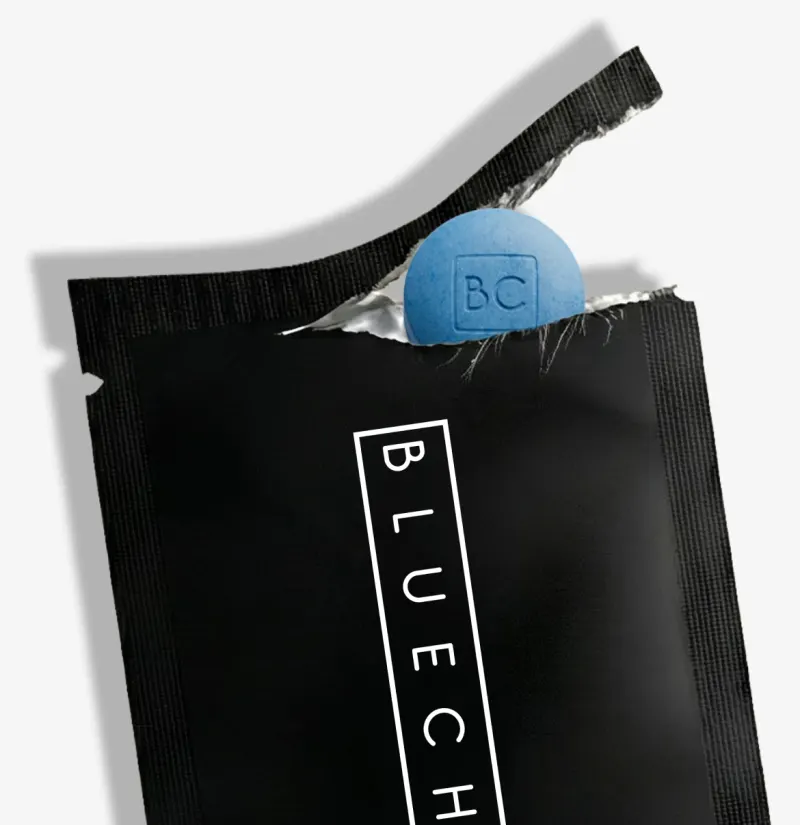
BlueChew provides prescription medications containing the active ingredients sildenafil, vardenafil, and tadalafil. Sildenafil, vardenafil, and tadalafil are the active ingredients in Viagra, Levitra, and Cialis, respectively.
BlueChew’s compounded medications are prescribed after an online provider review for erectile dysfunction and sexual performance enhancement. These medications are compounded and are not FDA-approved.
For men whose overthinking connects to performance worries, BlueChew products may be worth discussing with a licensed provider.
BlueChew’s complete product lineup includes:
- SIL: 45 mg sildenafil, works within 15 minutes, lasting up to 6 hours
- TAD: 9 mg tadalafil, effective within 15 minutes, lasting up to 36 hours
- VAR: 8 mg vardenafil, takes effect within 15 minutes, lasting up to 6 hours
- DailyTAD: 9 mg tadalafil plus 7 essential vitamins, lasting up to 36 hours
- MAX: 45 mg sildenafil + 18 mg tadalafil combo, lasting up to 36 hours
- VMAX: 14 mg vardenafil + 18 mg tadalafil combo, lasting up to 36 hours
- GOLD: sildenafil, tadalafil, oxytocin, and apomorphine sublingual tablet, lasting up to 36 hours
For new customers, GOLD offers a comprehensive approach, combining sildenafil and tadalafil for blood flow support with apomorphine and oxytocin to enhance arousal, sex drive, and intimacy. Learn more about how fast BlueChew GOLD works and whether it might be right for you.

Frequently Asked Questions
Can overthinking directly cause erectile difficulties?
Overthinking can contribute to erectile difficulties by increasing stress, distracting attention, and making it harder to stay relaxed and aroused. Erectile difficulties can also have physical causes, so persistent or concerning symptoms should be discussed with a healthcare provider.
Is it normal to feel anxious about sex?
Yes. Many people experience sexual nervousness at different points in life. It becomes a bigger issue when worry creates a repeated cycle that interferes with enjoyment, confidence, or connection.
How long does it take to see improvement with these techniques?
Improvement varies. Some people notice changes as they practice mindfulness, communication, and cognitive strategies consistently, while others may need additional support from a therapist or healthcare provider. Avoid treating any single timeline as guaranteed.
What's the difference between physical ED and psychological ED?
Physical ED may involve factors such as cardiovascular disease, diabetes, medication effects, or hormonal issues. Psychological ED may involve anxiety, stress, relationship concerns, or past negative experiences. Many cases involve a mix of physical and psychological factors, so medical evaluation can be helpful.
How can my partner support me in overcoming sexual performance anxiety?
Partners can help by creating a lower-pressure environment, focusing on intimacy rather than specific outcomes, and communicating openly. Some couples also find it helpful to slow down and focus on forms of connection that do not make erection quality the only measure of success.
This article is provided for informational purposes only and does not constitute medical advice. The information presented is not a substitute for professional medical advice, diagnosis, or treatment. Always consult your healthcare provider to discuss the risks, benefits, and appropriateness of any treatment.
BlueChew offers access to healthcare providers who may prescribe compounded medications for the treatment of erectile dysfunction.
The featured products include compounded medications that have not been approved by the FDA. Compounded medications may be prescribed under federal law but are not the same as, nor are they generic versions of, any FDA-approved medication. The FDA does not review compounded medications for safety, effectiveness, or manufacturing quality of compounded products. A prescription will only be written if deemed appropriate after the digital consultation by the licensed medical provider. Individual results may vary.
BlueChew is not a compounding pharmacy but a telemedicine service that links patients to licensed medical providers.
BLUECHEW EDITORIAL STANDARDS
BlueChew is committed to providing accurate, clear, and up-to-date health information. Our writers and medical reviewers rely on peer-reviewed research, clinical guidelines, academic institutions, government health agencies, and professional medical organizations. Whenever possible, we cite primary sources and update our content as new evidence becomes available.
See something that needs correction? Let us know at blog@bluechew.com.



 Medically reviewed