How to Recover Confidence After a Bad Night in Bed

It happens. One night, things just do not go as planned. Maybe stress from work followed you into the bedroom, maybe you had a few drinks at dinner, or maybe your body simply did not cooperate despite your best intentions. Whatever the cause, a disappointing sexual experience can shake your confidence and leave you feeling nervous about the next intimate moment.
One difficult night does not define your sexual future. Sexual performance anxiety is a recognized concern, and research published in the Sexual Medicine Reviews journal describes it as closely connected with sexual dysfunction and anxiety-related concerns. Understanding what happened, reframing your mindset, and taking practical steps can help you move forward with more confidence. Whether you are looking for communication tools, lower-pressure intimacy strategies, or support from BlueChew, this guide can help you reset after a difficult experience.
Key Takeaways
- One bad night is common and does not always indicate a long-term problem. Stress, fatigue, alcohol, anxiety, and relationship pressure can all affect sexual performance.
- Performance anxiety can create a feedback loop where worry about the next encounter makes it harder to stay present.
- Communication with your partner can prevent misunderstandings and reduce pressure.
- Focusing on sensation, connection, and pleasure instead of monitoring performance may help interrupt the anxiety cycle.
- If erection difficulties persist, a healthcare provider can help determine whether psychological support, lifestyle changes, medical evaluation, or prescription ED treatment may be appropriate.
- BlueChew offers prescription compounded medications for ED and sexual performance enhancement after an online provider review.

Understanding What Happened: Normalizing the Experience
Before you spiral into worry, remember that sexual performance can vary. Occasional erection difficulty can happen with stress, fatigue, alcohol use, nervousness, relationship tension, or distraction. That does not automatically mean you have ongoing erectile dysfunction.
Erectile Variability vs. Erectile Dysfunction
Erectile variability means your body responds differently based on circumstances. You might feel confident one night and struggle the next depending on:
- Sleep quality and fatigue levels
- Alcohol or substance use
- Stress from work, finances, or relationships
- Nervousness with a new partner
- General health and energy
- Pressure to “perform” perfectly
Erectile dysfunction, by contrast, involves ongoing difficulty achieving or maintaining an erection firm enough for sex. If the issue happens repeatedly or causes distress, it is worth speaking with a healthcare provider.
Why This Distinction Matters
Many men experience one bad night and immediately assume something is permanently wrong. That fear can make the next encounter feel higher stakes than it needs to be. When you understand that one difficult experience can fall within normal human variation, it becomes easier to approach the next intimate moment with less pressure.
The Performance Anxiety Cycle
Performance anxiety is not a character flaw. It is a stress response that can interfere with arousal and make it harder to stay present. Research on anxiety and erectile dysfunction has found that anxiety-related conditions are associated with ED, which supports the idea that mental and physical factors can overlap.
How the Cycle Works
When you worry about sexual performance, your body may shift into a stress state. That can make arousal more difficult, especially if you are monitoring your body instead of focusing on connection and pleasure.
The anxiety feedback loop can look like this:
- You experience one disappointing sexual encounter
- You start worrying about the next encounter before it happens
- Anticipatory anxiety increases pressure
- The pressure makes it harder to stay relaxed and aroused
- The feared outcome happens again, reinforcing the worry
The key insight: in some cases, the body may be responding to stress or pressure rather than a permanent problem. Reducing pressure can help, but persistent symptoms should still be discussed with a healthcare provider.
Breaking the Cycle
The goal is not to force confidence overnight. The goal is to reduce the pressure around sex so your body and mind can reconnect with pleasure. That may involve communication, relaxation strategies, temporary changes to sexual expectations, professional support, or medical evaluation when needed.
Is It Physical or Psychological? Identifying Possible Contributors
Determining whether your difficulty is mostly physical, psychological, or both can help guide your next step. Many cases involve overlapping factors.
Signs It May Be Primarily Situational or Psychological
- You still wake up with morning erections or have erections during sleep
- You can achieve erections through masturbation without the same difficulty
- The issue started suddenly after stress, conflict, or a disappointing encounter
- Difficulties happen only in certain circumstances or with certain pressures
- You do not have known health conditions or medication changes that commonly affect erectile function
Signs Physical Factors May Be Contributing
- You rarely or never experience morning erections
- Erection difficulties have developed gradually over time
- You have underlying health conditions like diabetes, heart disease, or high blood pressure
- You take medications that may affect sexual function
- Lifestyle factors like smoking, heavy drinking, poor sleep, or lack of exercise are present
For many men, addressing both psychological and physical factors leads to the best outcome. Even when anxiety is part of the issue, a medical evaluation can help rule out underlying contributors.
Practical Strategies for Rebuilding Sexual Confidence
Recovery is not just about waiting and hoping. Practical strategies can help you rebuild confidence and reduce pressure.
Reframe Your Thinking
After one bad night, it is easy to catastrophize. Instead of thinking, “This is going to happen every time,” try a more balanced thought: “One difficult experience does not define what will happen next.”
Helpful reframes include:
- “One disappointing night is information, not a life sentence.”
- “My worth as a partner is not measured by erection quality.”
- “Connection and pleasure can happen in many ways.”
- “My body may be responding to pressure, and pressure can be reduced.”
These reframes do not ignore the problem. They make the problem feel more manageable.
Focus on Sensation, Not Evaluation
Performance anxiety often grows when you start evaluating yourself during sex. Thoughts like “Is it working?” or “Am I hard enough?” can pull attention away from pleasure and connection.
Instead, try directing attention to:
- The feeling of touch on your skin
- Your partner’s responses and expressions
- Sounds, scents, and the overall atmosphere
- Emotional connection and closeness
- Breathing slowly and staying present
If evaluative thoughts show up, acknowledge them and gently return your focus to sensation.
Use Slow Breathing Before Intimacy
Before intimate moments, slow breathing may help you feel calmer and more present. Try inhaling for 4 seconds, holding briefly, and exhaling slowly. Repeat this a few times before getting physically close.
The point is not to perform a perfect breathing exercise. The point is to give your body a signal that you are safe, calm, and not being tested.
Consider Temporary Penetration-Free Intimacy
Some couples benefit from temporarily taking penetrative sex off the table. This can reduce performance pressure and make it easier to focus on touch, pleasure, and connection.
During this period:
- Focus on massage, oral stimulation, and manual touch
- Explore what feels good without making intercourse the goal
- Let arousal happen naturally without evaluating it
- Reconnect with pleasure rather than performance
This approach can be especially helpful when anxiety has made sex feel like a test.
Communicating With Your Partner
How you communicate about a disappointing experience can shape what happens next. Partners often blame themselves when sex does not go well. They may wonder whether you are still attracted to them or whether something is wrong in the relationship.
Have the Conversation Outside the Bedroom
Talk when you are both calm and not in the middle of an intimate moment. Keep the conversation simple, honest, and reassuring.
Conversation starters:
- “I want to talk about what happened the other night. It was not about you or my attraction to you.”
- “I have been stressed, and I think my body responded to that pressure.”
- “I want us to focus on connection and pleasure without pressure.”
- “Can we slow things down and take the pressure off intercourse for a little while?”
Create a Collaborative Approach
When both partners understand what is happening, sex can feel less like a performance and more like a shared experience. Your partner may also have ideas, reassurance, or preferences that help you feel less alone. Treating the issue as something you can work through together may strengthen intimacy instead of weakening it.
When to Seek Additional Support
If anxiety persists, therapy or counseling may help address performance worry, relationship stress, and thought patterns that keep the cycle going. A systematic review of psychological interventions for erectile dysfunction found that psychological interventions, including approaches combined with PDE5 inhibitors, may improve erectile function for some men.
Professional Options
- Sex therapy or counseling: Can help address performance anxiety, sexual expectations, and relationship dynamics.
- Medical evaluation: Can help rule out physical causes or medication-related contributors.
- Lifestyle support: Sleep, exercise, alcohol moderation, and stress management can support sexual health.
- Prescription ED medication: May be appropriate for some men when prescribed by a licensed provider.
You do not need to wait until the problem feels severe to ask for help. If the issue is causing distress or keeps happening, support is reasonable.
How BlueChew Can Help Support ED Symptoms
When performance concerns occupy your attention, it can be harder to stay present with your partner. For some men with ED symptoms, prescription treatment may help support erectile response, which can make it easier to focus on intimacy rather than monitoring performance.
BlueChew provides prescription compounded medications containing the active ingredients sildenafil, vardenafil, and tadalafil. Sildenafil, vardenafil, and tadalafil are the active ingredients in Viagra, Levitra, and Cialis, respectively. BlueChew’s products are compounded medications, not generics, and compounded medications are not FDA-approved.
Where GOLD Fits In
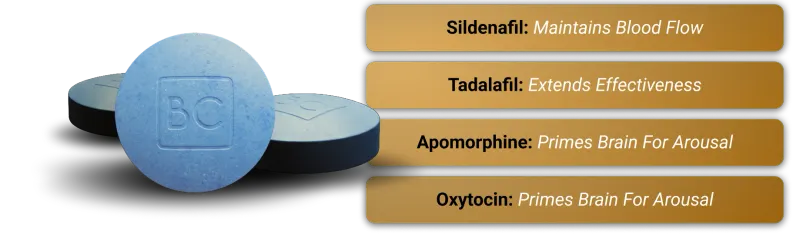
BlueChew GOLD is a sublingual tablet containing sildenafil, tadalafil, oxytocin, and apomorphine. A licensed provider can help determine whether GOLD or MAX is appropriate based on your health history and needs.
If anxiety is a major part of the issue, ED medication alone may not address the full picture. Communication strategies, stress management, therapy, and medical guidance may also help.
DailyTAD comes in a chewable tablet. SIL, VAR, TAD, MAX, VMAX, and GOLD are available as a sublingual tablet.
BlueChew’s complete product lineup includes:
- SIL: 45 mg sildenafil, from $3.53/tablet, works in 15 minutes, lasting up to 6 hours
- TAD: 9 mg tadalafil, from $4.47/tablet, effective within 15 minutes, lasting up to 36 hours
- VAR: 8 mg vardenafil, from $4.34/tablet, takes effect in 15 minutes, lasting up to 6 hours
- DailyTAD: 9 mg tadalafil plus 7 essential vitamins, $2.23/tablet, lasting up to 36 hours
- MAX: 45 mg sildenafil + 18 mg tadalafil combo, $5.63/tablet, lasting up to 36 hours
- VMAX: 14 mg vardenafil + 18 mg tadalafil combo, $5.63/tablet, lasting up to 36 hours
- GOLD: sildenafil, tadalafil, oxytocin, and apomorphine sublingual tablet, from $7.30/tablet, lasting up to 36 hours
BlueChew’s online process lets eligible users complete a consultation and provider review online, with discreet delivery if prescribed. You can learn more about how BlueChew works or how to create and manage your BlueChew account.
Frequently Asked Questions
How long does it take to recover confidence after a bad sexual experience?
Recovery varies. Some men feel better after one reassuring experience, while others need more time, communication, or support. If the concern keeps happening or creates ongoing distress, a healthcare provider or therapist can help identify possible contributors.
Should I tell my partner about my performance concerns?
Yes, communication often helps. Partners may assume sexual difficulty means they are not attractive or that something is wrong in the relationship. A calm conversation outside the bedroom can reduce pressure and help you work together.
Is one bad night a sign of erectile dysfunction?
Not necessarily. Erections can be affected by stress, fatigue, alcohol, nervousness, distraction, and relationship pressure. ED usually involves ongoing difficulty. If symptoms continue, it is best to speak with a healthcare provider.
Can BlueChew help after a bad night in bed?
BlueChew may help some men with ED symptoms by offering prescription compounded medications that support erectile response. It does not treat performance anxiety directly, so men with ongoing anxiety may also benefit from stress management, communication strategies, therapy, or couples support.
Which BlueChew plans are available to new customers?
New customers can choose from GOLD or MAX. SIL, VAR, TAD, DailyTAD, ENERGY, and VMAX are legacy plans and are only available to existing BlueChew subscribers already enrolled in those plans.
This article is provided for informational purposes only and does not constitute medical advice. The information presented is not a substitute for professional medical advice, diagnosis, or treatment. Always consult your healthcare provider to discuss the risks, benefits, and appropriateness of any treatment.
BlueChew offers access to healthcare providers who may prescribe compounded medications for the treatment of erectile dysfunction.
The featured products include compounded medications that have not been approved by the FDA. Compounded medications may be prescribed under federal law but are not the same as, nor are they generic versions of, any FDA-approved medication. The FDA does not review compounded medications for safety, effectiveness, or manufacturing quality of compounded products. A prescription will only be written if deemed appropriate after the digital consultation by the licensed medical provider. Individual results may vary.
BlueChew is not a compounding pharmacy but a telemedicine service that links patients to licensed medical providers.
Other Helpful Articles