ED in Young Men: 5 Real Causes and What Actually Helps

If you're a man under 40 dealing with erectile dysfunction, you're not broken, and you're not alone.
National survey data (NHANES) found that the prevalence of ED increases from about 5% in men aged 20 to 39, to nearly 15% in men aged 40 to 59, and clinic-based studies in younger populations often report considerably higher rates depending on how ED is defined.
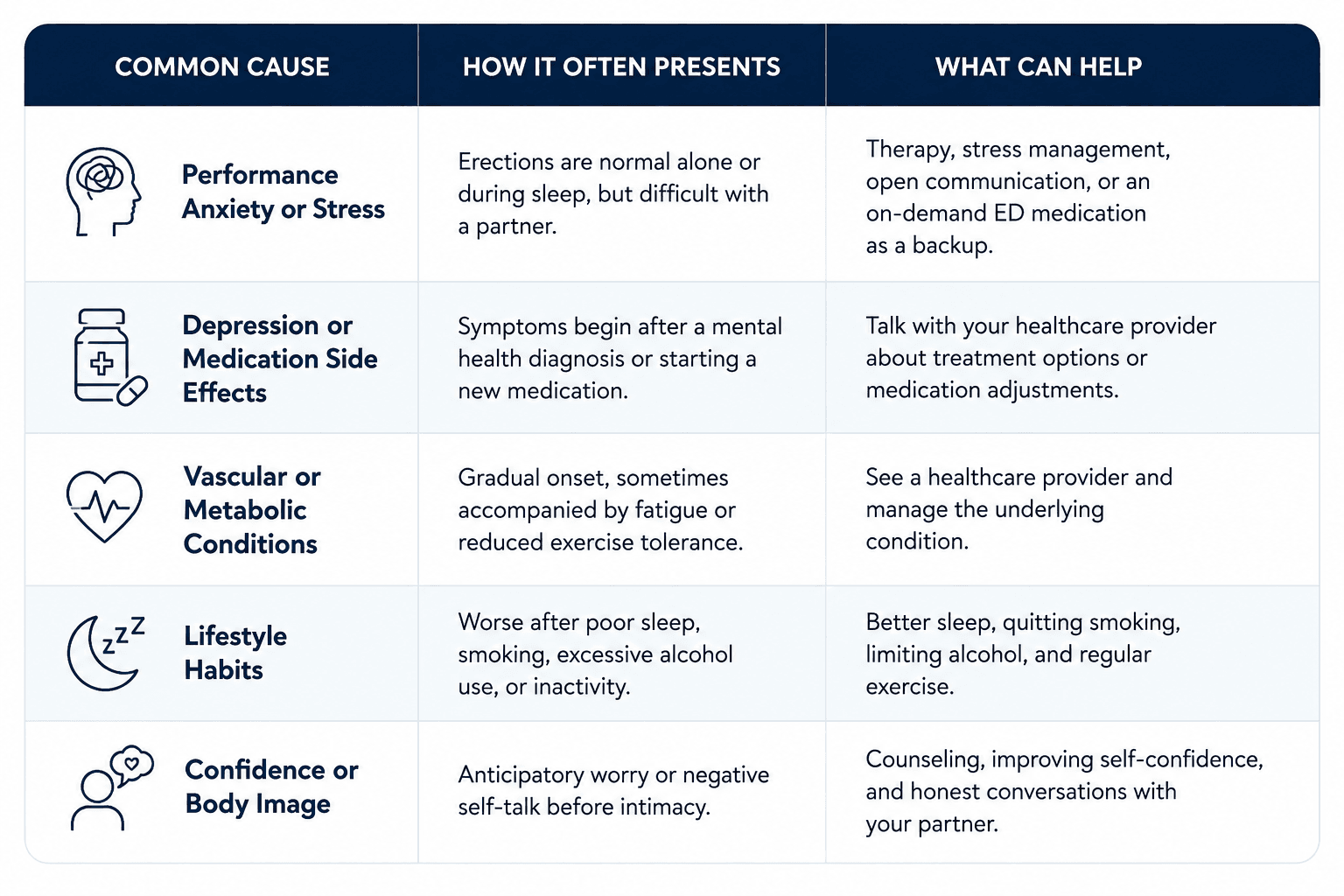
The most common causes are performance anxiety, mental health and its medications, underlying vascular or metabolic issues, everyday habits, and confidence or body image factors, not simply "getting older." Most of it is treatable, whether that means fixing the root cause, adjusting a habit, or using an on-demand medication like sildenafil or tadalafil while you work on the rest.
Key Takeaways:
- ED in young men is more common than most people assume, and rates in clinic-based studies run as high as 35%, well above the roughly 5% baseline from national survey data.
- Depression alone measurably lowers erectile function scores, and antidepressants add their own sexual side effects on top, affecting somewhere around 6 in 10 men who take common SSRIs.
- ED can show up years before a heart problem does. It's linked to a meaningfully higher overall risk of cardiovascular disease, not just an inconvenience.
- More than half of men with diabetes report some degree of ED, making it one of the strongest risk factors on this entire list.
- Poor sleep was linked to roughly 6x higher odds of ED in a study of college-aged men, a bigger effect than most people expect from sleep alone.
- About a third of young military personnel reported some level of ED, and it tracked closely with anxiety about body image, not just physical fitness.
- The most hopeful finding: lifestyle changes actually work. In a clinical trial, a third of obese men with ED saw real improvement from diet and exercise alone, no prescription required.
Is Erectile Dysfunction in Young Men Actually Common?
More common than most people think, and rising.
A 2025 narrative review in Cureus notes that ED prevalence in young men varies widely across studies, with some reporting rates as high as 35%, and that a meaningful share of these cases involve real physical factors, not just anxiety. The review's authors point out that ED is increasingly recognized in men under 40 rather than treated as a rare exception.
Cause 1: Performance Anxiety and Everyday Stress
The same Cureus review found that psychogenic causes like performance anxiety, depression, and relationship issues are common in young men, alongside physical factors such as endothelial dysfunction and hormonal imbalances.
Stress doesn't just live in your head—it affects your body, too. When you're anxious, your body shifts into "fight-or-flight" mode, making it harder for the blood vessels in the penis to relax and fill with blood. That means even if you want to have sex, your body may not cooperate.
Sometimes one difficult experience is all it takes to start a cycle of worrying about it happening again.
Cause 2: Depression, Anxiety Disorders, and Their Medications
Mental health can affect erections in a couple of different ways.
A 2025 cross-sectional study of young married men found that erectile function scores were significantly lower in men who screened positive for depression than in those who screened negative. Meaning depression was associated with lower erectile function. Many of the medications used to treat depression—especially SSRIs—can also cause sexual side effects, possibly compounding the problem.
A multicenter study of over 1,000 psychiatric outpatients found that the overall incidence of sexual dysfunction was about 59% across common antidepressants, and higher in men (62%) than in women, with SSRIs like paroxetine and citalopram among the more frequently implicated.
That doesn't mean you should stop taking your medication. If you notice changes after starting a new prescription, talk with your healthcare provider. In many cases, there are other options that may help.
Cause 3: Vascular and Metabolic Health, Even Before 40
Many people think heart disease only affects older adults, but the blood vessels that supply the penis are often the first place circulation problems show up.
In fact, a 2023 review in the Journal of the American College of Cardiology found that ED often precedes cardiovascular events and can serve as an early marker for identifying men at high risk of major cardiovascular disease. In other words, it may be an early warning sign of cardiovascular disease.
Similarly, diabetes is a major factor at any age. A meta-analysis of 145 studies covering nearly 90,000 men found an overall ED prevalence of 52.5% among men with diabetes.
If ED is new, persistent, or paired with symptoms like fatigue or chest discomfort, it's worth a checkup, not just a prescription.
Cause 4: Lifestyle Habits That Quietly Add Up
Your lifestyle doesn’t only determine how you look; it also determines how your body functions.
A 2023 study of university students in Peru found that erectile dysfunction was significantly more common among students with poor sleep quality, roughly six times more common after adjusting for other factors.
Smoking carries similar weight: a meta-analysis of eight studies covering over 28,000 men found smoking to be a consistent risk factor for ED.
The encouraging counterpart: a randomized controlled trial published in JAMA found that lifestyle changes, weight loss, and increased physical activity improved erectile function in roughly one-third of obese men with ED at baseline.
This means small, consistent lifestyle changes can actually improve erectile function.
Cause 5: Confidence, Body Image, and Relationship Factors
A study of 367 male military personnel aged 40 or younger found that more than a third reported some level of erectile dysfunction, and that anxiety about genital self-image was linked to it through sexual anxiety as the connecting factor.
Confidence issues create a self-reinforcing loop: one difficult experience leads to worry about the next, and the worry itself becomes the barrier.
Being open with a partner, rather than avoiding intimacy altogether, tends to break the cycle faster than silence does.

What Actually Helps Erectile Dysfunction in Young Men?
Most young-onset ED responds well to two things together: fixing the root cause, and having reliable support in the moment while you do.
For the root cause:
- See a doctor if it's new, persistent, or paired with other symptoms, to rule out vascular or metabolic issues.
- Talk to your prescriber if a medication may be contributing. Never stop a psychiatric medication on your own.
- Work with a therapist if anxiety, depression, or confidence issues are the main driver.
- Start with sleep, alcohol, and smoking from the lifestyle list; the evidence for these is strongest, and they tend to respond fastest.
For support in the moment:
PDE5 inhibitors (the same drug class as Viagra and Cialis) are the most well-established short-term option, and can be used safely alongside the fixes above once a doctor confirms they're appropriate for you.
BlueChew connects you with a licensed medical prescriber who can determine if erectile dysfunction medication is safe for you. No pharmacy pickup, no in-person appointment, just erectile health on your terms.
At a glance:
Final Thoughts
Erectile dysfunction in young men is more common than many people realize, and it's rarely caused by just one thing. Stress, anxiety, depression, medications, lifestyle habits, and underlying health conditions can all play a role. The good news is that most of these causes are treatable, and addressing them early can improve not only your sex life but your overall health.
If ED is becoming a recurring problem, don't ignore it or assume it's "just in your head." A conversation with a healthcare provider can help identify the underlying cause and determine the best treatment plan. For many men, that means combining healthy lifestyle changes, managing any medical or mental health conditions, and using an FDA-approved erectile dysfunction medication when appropriate.
If you're ready to explore treatment, BlueChew makes it easy to connect with a licensed medical provider online to see if prescription ED medication is right for you—all from the privacy and convenience of home.
How To Get Medication Through BlueChew
Interested in getting your hands on an erectile dysfunction prescription? BlueChew has got you covered.
Select a plan, complete an online intake, and you’re done. A medical provider will review your information and, if appropriate, prescribe your plan, which will be shipped directly to your door.
No doctor appointments or patient support charges make it a stress-free experience.
Plus, there’s no commitment—you can easily cancel or switch plans anytime. Click here to explore all plan options for treatments at BlueChew.
Frequently Asked Questions
Can a 20-year-old have erectile dysfunction?
Yes. NHANES data puts the national rate at around 5% for men in their 20s and 30s, and some clinic-based studies of younger men report considerably higher rates.
Can anxiety alone cause ED?
Yes. Research on young men has found that sexual anxiety directly mediates the relationship between psychological factors and erectile difficulty, even without an underlying physical cause.
Is occasional ED something to worry about?
Usually not. It's worth investigating when it's frequent, persistent, or paired with other symptoms.
Do ED medications work when the cause is psychological?
Often, yes. PDE5 inhibitors work on blood flow regardless of the original trigger, which is why they're frequently used as short-term support alongside therapy or lifestyle changes.
When should I see a doctor about ED?
If it's new, persistent, worsening, or paired with symptoms like fatigue or chest discomfort, since research links ED to elevated cardiovascular risk.
BLUECHEW EDITORIAL STANDARDS
This article is provided for informational purposes only and does not constitute medical advice. The information presented is not a substitute for professional medical advice, diagnosis, or treatment. Always consult your healthcare provider to discuss the risks, benefits, and appropriateness of any treatment.
BlueChew offers access to healthcare providers who may prescribe compounded medications for the treatment of erectile dysfunction.
The featured products include compounded medications that have not been approved by the FDA. Compounded medications may be prescribed under federal law but are not the same as, nor are they generic versions of, any FDA-approved medication. The FDA does not review compounded medications for safety, effectiveness, or manufacturing quality of compounded products. A prescription will only be written if deemed appropriate after the digital consultation by the licensed medical provider. Individual results may vary.
BlueChew is not a compounding pharmacy but a telemedicine service that links patients to licensed medical providers.
RELATED ARTICLES



Have Better Sex
- 100% online process
- No office visit required
- Discreet shipping, if prescribed
*Prescription products require an online review by a licensed provider. Restrictions apply.

 Medically reviewedEvery article is reviewed by a licensed provider on the BlueChew medical team.